Sunday, October 3, 2010

Havana Brown

The Havana Brown, also known as the Swiss Mountain cat, is a breed of cat well known and shown in England in the 1890s.
Similar to the oriental shorthair, full color cats, also known as non-blue eyed Siamese, were known to interbreed with the pointed cats of Siam.
The Havana Brown is a moderately sized, muscular short-haired cat with a body of average length. The coat color must be brown, typically reddish-brown, with no tabby markings. Whiskers should also be brown and the eye color should be green. The head should be slightly longer than wide and the nose should have a distinct stop at the eyes. Males tend to be larger than females and are average in weight compared with other breeds.
The Havana Brown is an intelligent cat that often uses its paws both to examine objects and to communicate with its owners. The most likely explanation of the breed's name is that its coat color is very similar to that of Havana cigars, however, some have also argued that the breed's name is also derived from the Havana (rabbit) which also shares the color.

Exotic Shorthair

The Exotic has a compact, rounded, powerfully-built body with a short, thick "Linebacker" neck. Its large round eyes, short snub nose, sweet facial expression, and small ears give it a highly neotenic appearance that some people may consider cute.
Head: Round, massive. Very broad skull. Rounded forehead. Round, full cheeks. Short, broad, round muzzle. Short, broad nose with pronounced stop. Strong chin. Broad, powerful jaws.
Ears: Small, rounded at the tip, not too open at the base. Widely spaced and well-furnished with hair on the inside.
Eyes: Large, round, well-spaced. Pure, deep color corresponding to that of the coat (gold to copper in most varieties; green in the chinchilla and the golden; blue in the white and the colorpoint).
Neck: Short and thick.
Body: Medium in size, cobby, low to the ground. Broad chest. Massive shoulders. Large-boned, powerful muscles. Weight: 3,5 - 6 kilogram.
Paw: Short, straight, and large. Round, large paws. Tufts of hair between the toes are desirable.
Tail: Short, thick, carried low. Rounded tip.
Coat: Shorthaired but slightly longer than that of other shorthaired breeds. Dense, fluffy, erect hair. All Persian colors are recognized.
The Exotic Shorthair has a gentle and calm personality reminiscent of the Persian, but it is livelier than his longhaired ancestor. Curious and playful, it is friendly to other cats and dogs. It rarely meows. It doesn’t like being left alone, and needs the presence of its owner (or of voices or smells reminiscent of its master-such as a radio kept on). They tend to show more affection and Loyalty than most breeds and make excellent lap cats. Their calm and steady nature makes them ideal apartment cats for city dwellers. Nonetheless, Exotics retain some of the energetic spark of their American Shorthair forebears and they are often capable mouse hunters.
Unlike the high-maintenance Persian, the Exotic is able to keep its own fur tidy with little human assistance, though weekly brushing and combing is recommended to remove loose hair and reduce shedding and hairballs.
As with other flat-faced animals, the Exotic's tears are prone to overflowing the nasolacrimal duct, dampening and staining the face. This can be relieved by periodically wiping the cat's face with a cloth moistened with water or one of the commercial preparations made expressly for the purpose.
This breed does not reach maturity until around two years of age and enters puberty fairly late. When two Exotic Shorthairs are crossed, they may produce longhaired kittens called “Exotic Longhairs” by the C.F.A. but considered Persian by other registering bodies. Externally they look like Persians.

European Burmese

Originally, Burmese cats were exclusively brown (sable), but years of selective breeding have produced a wide variety of colours. Different associations have different rules about which of these count as Burmese. Burmese cats are known for being sociable and friendly with humans, as well as very intelligent. They are also very vocal, and often call to their owners.
The accepted eye colour for the breed is gold or yellow. The coat is known for being glossy, with a satin-like finish. As with most short-hairs, it requires no additional grooming. The shape of the British breed is more moderate but must not be Oriental, while the American breed is sturdier in build. Longer lived than most pedigree cats, they often reach 16 to 18 years of age. Burmese are a small to medium size breed and tend to be about 4–6 kg in weight, even though the breed are a lot heavier than they first appear.
Burmese are vocal like the Siamese but have softer, sweeter meows. They are very affectionate and enjoy company, being a people oriented breed who form strong bonds with their owners and gravitate toward human activity. Burmese need a reasonable amount of human attention, are not as independent as other breeds and are not suited to being left alone for extended periods of time. The Cat Fanciers' Association (CFA) breed information on the Burmese implies that all survival instinct of flight or fight seems to have been bred out of them. However, other sources note that, while rarely aggressive with humans, Burmese cats can defend themselves quite well against other cats, even those larger than themselves.
Burmese are known as the 'clowns of the cat world' and maintain kitten interests and energy throughout their adulthood. They have a number of dog-like characteristics, often learning to play fetch and tag. Burmese are good with children and dogs. They are suitable as an indoor breed of cat, will usually stay more affectionate if kept indoors and are comfortable travelling in cars.

Egyptian Mau

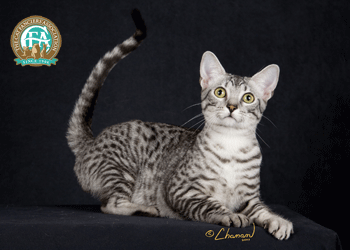
Egyptian Maus are a small-medium sized short-haired cat breed.
a balance between the compactness of a Burmese and the slim elegance of a Siamese. Its medium-length body is muscular, with the hind legs longer than the front, giving the Mau the appearance of standing on tiptoes when upright.
The Egyptian Mau is the fastest of the domestic cats, with its longer hind legs, and unique flap of skin extending from the flank to the back knee, provides for greater agility and length of stride. Maus have been clocked running over 30 mph (48 km/h).
Maus often possess very musical voices. They are known to chirp, chortle and emit other distinctly unusual vocalizations when stimulated.
Another behavior, quite common in happy Maus, has been described as "wiggle-tail." The cat, male or female, wiggles and twitches its tail, and appears to be marking territory, also known as spraying, but it is not actually releasing urine. Even veteran Mau owners are known to check after a joyous Mau does this little dance.
The exact origin of the Egyptian Mau is not recorded and therefore cannot be known for certain. The Egyptian Mau is often said to be descended from African wild cats, and its ancestor is depicted essentially unchanged in wall paintings of Ancient Egypt. The breed name itself references the Middle Egyptian word mau (literally, cat).
The modern Mau is said to have originated in 1953, Italy, when exiled Russian Princess Natalie Troubetskaya met the cat of the Egyptian Ambassador to Italy. She convinced him to obtain several cats from Egypt for her, and she began to breed them. From her the Mau has been described as having a "troubled" look, with their round eyes and open expression. The Mau achieved championship status in some organisations in 1968. There were attempts by British breeders to create Maus from cross-breeds of Abyssinians, Siamese and tabbies, however these did not resemble the true Maus. This mix became the basis for the Ocicat.
Maus are more temperature sensitive than most breeds, they are fond of very warm temperatures. They are more sensitive to medicines and anesthesia. Maus allegedly have an unusually long gestational period, about 73 days. The maximum normal period for cats is 65-67 days, although Siamese may take a day or two longer. The typical Mau is known for having what is considered a loyal, friendly but slightly dog-like personality.
Albeit largely anecdotal, the Egyptian Mau is well known for intelligence and close bonding with responsible and loving owners. Such owners typically report their Maus eagerly greet them at the door at the end of a long day at work. Usually requiring more effort than other breeds, Maus can be "lap cats," but their alert nature makes the task difficult. Although ill-advised by most veterinarians and animal-care givers, the Egyptian Mau loves an outdoor life. Their speed, coupled with their innate intelligence, allows them to avoid almost all dangers if carefully introduced to an outdoor world very early in life. Unusually averse to loud noises and fast-moving objects, Maus are rarely "road kills," and instead are far too busy decimating the mouse and rat population in the back yards and farms of your neighbors. Many responsible farmers report that a few Mau crossbreeds have saved entire crops from rodents. The typical Mau is not social with strangers of any species, other cats in particular. As kittens, maus will also test out their ability to attack and scratch. Providing them with large sausage-like dog toys so they can practice "gutting" and "killing" is a must if you want your cat to be a ratter. Also, they are very hard to wash if you do not have thick gloves or thick skin. Maus will fight trespassing cats with astonishing ferocity and uncannily disappear from strange and loud humans. Accordingly, the Egyptian Mau is not a good choice for an absentee condo owner who, when home, brings in strange pets and humans. But over-all, the Mau is a great pet known for creating a special and strong bond with generally one or two people in the family.
Egyptian Maus are a relatively rare breed to encounter. As of 2007, fewer than 200 kittens are registered with the GCCF each year. As of 2006, a total of 6741 Maus are registered with the CFA. Maus come in five colors. From most to least common these colors are: silver, bronze, smoke, black and blue/pewter.
Black and pewter Maus cannot be shown, but may be used in breeding. All Maus must have green eyes, but an amber cast is acceptable in kittens and young adults up to eighteen months old.

Thursday, September 2, 2010

Devon Rex


The Devon Rex is a breed of cat that emerged in England during the 1960s. They are known for their odd, striking appearance and playful, companionable nature.
The Devon Rex is a breed of cat with a curly, very soft short coat similar to that of the Cornish Rex.
The curl in Devon Rex fur is caused by a different mutation and gene than that of the Cornish Rex and German Rex, and breeding of a Devon with either of those cats results in cats without rexed (curled) fur. Devons, which are medium sized cats, are often called "pixie cats" or "alien cats" because of their unique appearance. Their uncommonly large ears are set low on the sides of their wide heads, their eyes are large, and their noses are slightly upturned. Unlike most cats their whiskers are very short and often curled to such an extent that it may appear as if they have no whiskers. Their body type is distinctly lightly-built. Their long, sturdy legs are well suited for long leaps, and their toes are unusually large. Devon Rex cats come in all colours. The ears are large and slightly rounded.
The typical Devon is active, mischievous, playful, and very people-oriented. They have been described as a cross between a cat, a dog and a monkey (or, more famously, as "a monkey in a cat suit"). They are high-jumpers and will try to occupy any space large enough to admit them. With this trait, they are often found in odd nooks and crannies of a closet, shelf, or laundry basket. Devons prefer to be in high places and will go to great lengths to get to the highest spot in a room. They are relatively easy to take care of. Most Devons also have one central person to whom they devote their love, and on whom they will most often lie and rub (citation needed). They like to playfully nip, and love to play throughout their lives.
They are a very intelligent breed; the typical Devon Rex can be trained to walk on a leash, fetch or perform all manner of tricks usually associated with canines, like jump, heel and tag to name a few.
Another common trait is their show of affection: they have a particular penchant for being close to the head or neck of their human companions and can often be found mounted upon ones shoulder or nestled into the cranny created by the neck and shoulder when one is prone. The Devon Rex is a faithful companion and will usually follow the object of their affection from room to room, waiting for the opportunity to leap onto their arms, lap, or shoulder.

Cornish Rex


The coat of a Cornish Rex is extremely fine and sometimes curly, the softest of any cat breed. However, their light coat means that they are best suited for indoor living in warm and dry conditions, they might get hypothermia if they stay outdoors in the winter. Their body temperature is slightly higher than most cats (102 F), and these cats tend to hang around light bulbs, the tops of computer monitors, and other warm places including laps and shoulders. Some Cornish Rexes also have a mild cheesy smell peculiar to the breed; this odour comes from scent glands in the paws.
Often the breed is referred to as the Greyhound of the cats, because of the sleek appearance and the galloping run characteristic of the breed. These cats tend to stay playful and kittenish throughout their long lives. Some Cornish Rexes like to play fetch, race other pets, or do acrobatic jumps. The Cornish Rex is an adventurous cat and is very intelligent. It can readily adapt to new situations and will explore wherever it can go, jumping into refrigerators, examining washing machines, etc. Some humans consider its antics to be deliberately mischievous. The Rex is extremely curious, seeks out the company of people and is friendly towards other companion animals. It is a suitable pet for timid children.
Cornish Rex cats come in a wide variety of coat colours and patterns, outlined in the standard solids, including white, black, chocolate, orange and the dilutes blue, lilac and cream; all forms of tabby including classic, mackerel and ticked tabbies, bicolor "tuxedo" coat in many colours, tortoiseshell, "smoke" colours and the elegant colour-point pattern standard in the Siamese breed.
Despite some belief to the contrary, the Cornish Rex's short hair does not make it non- or hypo-allergenic. Allergic reactions from cats are not the result of hair length, the true culprit is a glyco-protein known as Fel d1, produced in the sebaceous glands of the skin, saliva, and urine. Most people who have cat allergies are reacting to this protein in cat saliva and cat dander: when the cat cleans its fur, the saliva dries and is transformed into dust which people breathe in. Since Cornish Rex cats groom as much as or even more than ordinary cats, a Cornish Rex cat can still produce a reaction in people who are allergic to cats. However, it is widely reported to cause lesser to little allergic reaction. It is recommended potential owener visit a cattery to check their own tolerance. Note that, for more serious allergies, there are several breeds theorized to lack or produce less of the offending protein.

Colorpoint Shorthair


The Colorpoint Shorthair is a highly intelligent, playful, and people-friendly breed. They are extremely affectionate and outgoing and enjoy lounging around and playing with people, causing them to also be described as "extroverts". They can also be very sensitive with nervous temperaments, which do not adapt well to changes of environment or to strangers. Like Siamese, they can be extremely vocal and attention-demanding, feeling a need for human companionship. They have over 100 vocal sounds, much more than regular cats.

Friday, June 25, 2010

CHARTREUX CAT

Chartreux

The Chartreux is an internationally recognized breed of domestic cat from France. The Chartreux is large and muscular, with short fine-boned limbs, big paws, and very fast reflexes. They are known for their blue (grey) water-resistant short hair double-coats which are often slightly nappy in texture (often showing "breaks" like a sheepskin) and orange- or copper-colored eyes. Chartreux cats are also known for their "smile"; due to the structure of their heads and their long, tapered muzzle, they often appear to be smiling. Chartreux are exceptional hunters and were highly prized by farmers.
Chartreux cats tend to be quiet, rarely making noises such as mewing or crying, and some are mute. They are quite observant and intelligent, with some Chartreux learning to operate radio on/off buttons and to open screen door latches. They take about two years to reach adulthood. Chartreux cats are playful cats well into their adult years; some can be taught to fetch small objects in the same manner as a dog. Chartreux are good with children and other animals. They are non-aggressive, affectionate, good travelers and generally very healthy. Chartreux tend to bond with one person in their household, preferring to be in their general vicinity (often following their favoured person from room to room), though they are still loving and affectionate to the other members of the household.

BURMESE CAT

Burmese


Burmese are vocal like the Siamese but have softer, sweeter meows. They are very affectionate and enjoy company, being a people oriented breed who form strong bonds with their owners and gravitate toward human activity. Burmese need a reasonable amount of human attention, are not as independent as other breeds and are not suited to being left alone for extended periods of time. The Cat Fanciers Association (CFA) breed information on the Burmese implies that all survival instinct of flight or fight seems to have been bred out of them. However, other sources note that, while rarely aggressive with humans, Burmese cats can defend themselves quite well against other cats, even those larger than themselves.
Burmese are known as the 'clowns of the cat world' and maintain Kitten interests and energy throughout their adulthood. They have a number of dog-like characteristics, often learning to play fetch and tag. Burmese are good with children and dogs. They are suitable as an indoor breed of cat, will usually stay more affectionate if kept indoors and are comfortable traveling in cars.
The first blue Burmese was born in 1955 in England. This was to be followed by red, cream, and tortoiseshell kittens over the next couple of decades. Much effort was put in to remove banding patterns from the coats, and to decide whether these new colours counted as Burmese. Champagne coloured cats (known as "chocolate" in the UK) appeared in America, but breeding was impeded by the refusal of breed clubs to acknowledge that Burmese cats could be any colour other than Brown. In 1971, the first lilac kitten was born, being the latest solid colour introduced in Burmese. Throughout the 1970s, brown, chocolate (champagne), blue, and lilac tortoiseshell types were developed in England. In America, the chocolate (champagne), blue, and lilac (platinum) colors were accepted for registration as a separate breed, the Malayan in 1979. In 1984, the champagnes, platinums, and blues were accepted for registration as Burmese. CFA organizes the champagne, blue, and platinums in the "dilute" division and the sables in the sable division. Cinnamon, Fawn, Caramel, and Apricot Burmese were developed in New Zealand from a breeding programme initiated by geneticist Dr Rod Hitchmough. The first cinnamon Burmese was Arsenios Cinnamon Dream Boy.
From the 1950s onwards, countries in the commonwealth and Europe started importing Burmese cats from Britain. As a result, most countries based their Standard of Points for this breed on the British model, rather than the American.
Burmese cats have been instrumental in the development of other domestic cat breeds, including (but not limited to) the Tonkinese, the Bombay, and the Burmilla.
As a result of these separate breeding programmes, British Burmese are different from American Burmese. The British build tends to be more Oriental, with a more triangular face, while the American Burmese is stockier and rounder in the body, head, eyes, and feet. It has markedly full cheeks and a short muzzle, sometimes called "pug-like". In the British type, both the American Burmese's "cobbiness" and the obvious Siamese influence long seen in the breed are today considered grave, even disqualifying faults.
For the past thirty years, there has been controversy over the appearance of the breed, which can now be divided into two camps. American breeders prefer the "contemporary Burmese" ("American Burmese") which has shorter noses and rounder skulls. The "traditional Burmese" (or "British Burmese") was declassed by the Cat Fanciers' Association in the 1980s. England's Governing Council of the Cat Fancy took the opposite approach and banned the registration of all Burmese imported from America in order to preserve the "traditional" bloodlines.
The controversy revolves around the fact that "contemporary Burmese" sometimes carry alleles for the "Head Fault", a lethal head defect. The head fault rarely occurs with "traditional Burmese". Its widespread presence in the American lineages goes back to a cat named Good Fortune Fortunatas, a fine example of the "contemporary" body/head type, although the defect was present in Burmese cats before Fortunatas. This individual was extensively mated to Burmese cats in the USA, and today's show-type American Burmese cats can usually trace their lineage back to it.

Monday, March 29, 2010

British Shorthair


The British Shorthair is a domesticated cat whose features make it a popular breed in cat shows. Indeed, it has been the most popular breed of cat registered by the UK's Governing Council of the Cat Fancy (GCCF) since 2001, when it overtook the Persian breed.

British Shorthairs have dense, plush coats that are often described as crisp or cracking, referring to the way the coat breaks over the contours of the cat's body. Eyes are large, round and widely set and can be a variety of colours, though the copper or gold eyes of the British blue are the best known. Their heads are round with full, chubby cheeks. Their bodies are large, sturdy, and muscular and are described as having a "cobby" build. The breed has a broad chest, shoulders and hips with short legs, round paws and a plush but not fluffy tail that ends in a round or blunt tip. These are the characteristics listed in most governing bodies breeds standards to which show cats must conform.

The males of this breed are larger than the females, and the size difference between them is more easily noticed compared to other breeds. The males' average weight is 5-10 kilograms, whereas a female would weigh up to 5-7 kg. As with many breeds, the adult males may also develop prominent cheek jowls that distinguish them from their female counterparts. The typical lifespan of this breed is 14 to 20 years.

The British Shorthair is a very strong cat, with a body shape which people refer to as “square”, as it is nearly as long in length as it is broad. The legs on the British Shorthair are quite thick to hold up their heavily muscled body. Due to its bulk and muscle, this type of cat is often referred to as the bulldog of the cat world. The male version of the breed is much larger than the female.

British Shorthairs have large, broad heads. Their cheeks are chubby, giving them a chipmunk-like appearance. Their eyes stand out a lot and tend to be large and of a copper colour. Their relatively small sized ears with rounded tips are set far apart, making the head look quite domed. They have pert snub noses and slightly rounded chins which help emphasise the breed's powerful jaw and round head.

British Shorthairs come in many colours. For many years, the more popular blue variant was common enough to have a breed name of its own: the "British Blue." It remains one of the most popular colours in the breed, though there is now a large variety of other colour and pattern variants accepted by most feline governing bodies and associations. These include the colours black, blue, white, red, cream, chocolate, lilac, cinnamon and fawn. British Shorthairs can be bred in "self" or "solid", which are all one colour, as well as the colourpoint, tabby, shaded and bicolour patterns. All colours and patterns also come in the tortoiseshell pattern, which is a combination of red and cream with other colours.

British Shorthairs are an easygoing breed of cat. They have a stable character and take well to being kept as indoor-only cats, making them ideal for apartment living. They are not terribly demanding of attention, though they will let their owner know if they feel like playing. They enjoy mouse type or stick style toys. They are not hyperactive or "in your face" cats, preferring to sit close to their owners rather than on them. They might supervise household activities from a comfy perch or perhaps the floor.

British Shorthairs are wonderful cats for people who work, as they are very happy to simply laze around the house while their owner is out. They do not get destructive or need other animals for company, though they do enjoy having another British Shorthair or a cat with similar temperament around.

They like attention and enjoy being petted. They are not a very vocal breed but will meow to communicate with their owners, for example when they are hungry and their food is being prepared. They may also meow at their favourite toy as they play with it. They tend to scratch closed doors when they want to get through, instead of meowing like most cats. British Shorthairs have a tendency to follow people from room to room, as they may want to be with their owner and see what is going on. Some do not mind being cuddled, but most prefer to keep four paws on the ground and be patted rather than picked up.

The breed has become a favourite of animal trainers because of its nature and intelligence, and in recent years these cats have appeared in Hollywood films and television commercials. They can learn small tricks spontaneously.

British Shorthairs do not require a lot of grooming as their fur does not tangle or mat easily. However, it is recommended that the coat be brushed occasionally, especially during seasonal shedding, since they may develop hairballs at this time. British Shorthairs can be prone to obesity when desexed or kept indoors, so care should be taken with their diet.

Friday, March 26, 2010

BOMBAY CAT

Bombay
The British Bombay cat is the name given to black cats of the Asian group. It is a cat of Burmese type with a black coat, toes, nose, and copper to greenish eyes. The close lying, sleek and glossy black coat should be coloured to the roots, with little or no paling. The Bombay is a shorthair breed of domestic cat, closely related to the Burmese.
The American breed called Bombay was bred in 1958 in Louisville, Kentucky, when Nikki Horner of Shawnee Cattery deliberately bred an Amerivan Shorthair with a Burmese for the purpose of creating a domesticated cat that resembled a "miniature black panther". These cats have copper or golden eyes, and a striking satin-like jet black coat. Occasionally, a Bombay kitten may be born sable colored, because of its relation to the Burmese. American Bombays are often confused with the British Bombay. Note that they are different cats though they both share the name of "Bombay." The offspring of this breeding did indeed resemble the black Leopard of India. The name came from the Indian city of Bombay (now Mumbai). The American Bombay is also at times referred to as the "Patent Leather Kitty with the Copper Penny Eyes."
The Bombay is a muscular, yet agile, cat with a black coat. The heads of British Bombay cats are rounded and wide with a medium short, blunt tapered muzzle. The eyes, which are usually brown or green in color , should be shaped like a Burmese cat's (not round) and set wide, and their ears are broad, slightly rounded and medium sized and, like the eyes, set wide. The American Bombay should have copper or golden eyes and a jet-black coat (occasionally sable), with the same eye shape, and a rounded head. There should be no edges in the shaping of the Bombay's head, and the ears are also slightly rounded at the tips. This cat also looks like a miniature panther giving it the nickname "the parlor panther". The Bombay has a coat that is short, satiny, high-gloss and tight to the body, thus giving it another name the Patent Leather Cat. Bombay cats require little grooming. They have personalities like Burmese cats as they are virtually genetically the same they are fun loving and very affectionate.
Both the American Bombay and British Bombay have very unique voices. They are not a traditional "meow". While some cats are very vocal, others tend to keep quiet. This is perfectly normal and just reflects the type of personality the Bombay cat has. Bombay cats are heat-seekers, meaning that they love to be warm and will tend to sleep with you either under the covers or on top of your legs because of the heat you emit. It shouldn't be a surprise if you sit down on the couch and soon after, your Bombay sits next to you. They're very beautiful and affectionate cats that love human attention.
In February 2010, The Bombay won "Best Breed of cat" for the first time in 50 years.

Friday, March 12, 2010

BIRMAN CAT

Birman

The Birman is a domestic cat breed. Also known as "Sacred Cat of Burma" (particularly so in some languages), it is not to be confused with the Burmese, which is a separate and dissimilar breed. The Birman has a pale coloured body and darker points with deep blue eyes. The Birman breed is recognized[5] by the Cat Fanciers' Association (CFA) and by the Canadian Cat Association (CCA).
Birmans have semi-long, silky hair, a semi-cobby body and relatively small ears compared to other cat races. In order to comply with breed standards, the Birman's body should be of an eggshell colour or golden, depending on the intensity of the markings colour. The markings can be pure seal, chocolate, blue, red, lilac or cream. Tabby variations are also allowed. Tortie cats can be seal, chocolate, blue or lilac. Birmans have sapphire coloured eyes.
The Birman's coat is unusual due to the white 'gloves' on each paw. They are one of the few cat breeds in the colourpoint coat that has fingers and toes in pure white colour. The genetics of this feature may not be not fully clear, though a gene conferring the white 'gloves' has been identified.
All Birmans are born white (as other colourpoint kittens are) and they start developing their colours at the age of 1 week if they have a dark colour (as seal-point) and at the age of 14 days, or more, if they have a clear colour (as lilac-point). The first part which develops the colour are the points of ears, nose and tail. The real colour is complete at two years old and after a wintry season.
Points of Sacred Birman are: Seal-point, Blue-point, Chocolate-point, Lilac-point, Seal Tortie-point, Cream-point, Blue Cream point, Chocolate Tortie point, Lilac Tortie point. The same colours in Tabby version (Lynx): Seal Tabby point, Blue Tabby point, Chocolate Tabby point, Lilac Tabby point, Red Tabby, Cream Tabby point, Tortie Tabby point, Lynx or Red Factor colors on the legs, tail and face. Birmans differ from conventional colour-point cats by their white paws called gloves. The coat is medium-length, not as long and thick as a Persian's, and does not mat. A notable feature is their clear blue eyes, which remain blue throughout their life.
The only allowed white areas are gloves. A spot of white in another area is a fault in a Sacred Birman cat. Gloves are symmetrical in all four feet. The white must stop at the articulation or at the transition of toes to metacarpals, and all fingers must be white too. The posterior gloves on the back paws finish with an inverted V extended 1/2" to 3/4".
Birmans have been bred for their temperament, and companionship, and they form a great affinity with their owner and their family. As all cats, they are highly intelligent creatures, and seem to take a genuine interest in whatever is taking place around them. They are also very inquisitive, and playful, particularly when young, and require plenty of stimulation and attention.

Thursday, March 11, 2010

BALINESE CAT

Balinese

The Balinese is a breed of oriental cat with long hair and Siamese-style markings, or points. It resembles a Siamese with a medium-length silky coat and a plumed tail, but is not nearly as fluffy as a Himalayan, and requires much less grooming. Balinese are extremely intelligent cats, although less talkative than their Siamese ancestors.
According to "Encyclopedia of Cat Breeds" by J. Anne Helgren 1997 Barron's Educational Series Inc., which has a rating scale on intelligence and other breed traits, the Siamese and Balinese are rated the highest 9-10 on a scale of 1 to 10. The Balinese is rated the highest in intelligence of all the long-haired breeds. Other breeds such a Persians rate a 6, Himalayans 7 and Tonkinese 8.
Balinese tend to live between 18 to 21 years.
Like the Siamese, there are now two different varieties of Balinese being bred and shown "traditional" Balinese and "contemporary" Balinese. The traditional Balinese cat has a coat approximately two inches long over its entire body and it is a sturdy and robust cat with a semi-rounded muzzle and ears. The traditional Balinese closely resembles a Ragdoll cat although they do not share any of the same genes or breeding other than having a partially Siamese ancestry. A "contemporary" Balinese has a much shorter coat and is virtually identical to a standard show Siamese except for its tail, which is a graceful silky plume. Like the Siamese, the Balinese has a long, slim body, wedge-shaped head, and vivid blue eyes. Its soft, ermine-like coat is short in comparison to those of other longhaired cats, and doesn't form a ruff.
Like the Siamese, the Balinese loves attention; it is very playful and fond of human company. The Balinese is a gregarious creature; while it still "talks" like its Siamese cousin, its voice is far softer, and it speaks only when it has something it feels is important to say.
In most associations, the Balinese is accepted in a full range of colors, including the four traditional Siamese point colors of seal, blue, chocolate, and lilac, as well as less traditional colors such as red and cream, and patterns such as lynx (tabby) point and tortie point. However, in the Cat Fanciers' Association, the Balinese is only accepted in the four traditional Siamese colors; all other colors and patterns are considered Javanese.

Wednesday, March 10, 2010

American Wirehair

The American Wirehair is a breed of domestic cat that originated in upstate New York. As of 2003, though the breed is well known, they are ranked as the most rare of the 41 CFA breeds, with only 22 registered, down from 39 in 2002.
The unique wirehair coat is genetically dominant over a normal coat, unlike the gene that creates rex fur. The fur is springy, dense and coarse, and even their whiskers are often curled. Many find it pleasant to the touch. It is unusual in that this coat has not appeared among other cats (most mutations occur in various places), and all wirehairs can trace their ancestry back to Adam. Apart from the wiry coat, they are strong, muscular cats, built similarly to American Shorthairs. They come in a variety of colors.
They are said to be adaptable cats resistant to disease.
They are described to be intelligent, affectionate, calm, reserved, loyal, playful, and inquisitive cats.

Tuesday, March 9, 2010

American Shorthair


The American Shorthair (ASH) is the 8th most popular breed of cat in the United States, according the Cat Fancier's Association for 2006–2007. The breed is believed to be descended from English cats (the forebears of today's British Shorthairs) brought to North America by early British settlers to protect valuable cargo from mice and rats.
A very athletic cat, American Shorthair has a larger, leaner, and more powerfully built body than its relation, the British Shorthair.
American Shorthairs are a pedigreed cat with strict standards and a distinctive appearance as set by the various Cat Fanciers Associations worldwide.
Originally known as the Domestic Shorthair, the breed was renamed in 1966 to the "American Shorthair" to better represent its "All American" character and to differentiate it from other shorthaired breeds. The name "American Shorthair" also reinforces the notion that the American shorthair is distinct from non-pedigreed, short-haired cats in the United States.
A non-pedigreed shorthaired cat (called a Domestic shorthair) might resemble an American Shorthair, just as another non-pedigreed cat might look like a Siamese, Persian or Maine Coon. The difference, however, is that American shorthairs are a pedigreed cat and are recognized as such by the Cat Fanciers' Association (CFA).
According to the CFA, American Shorthairs are low-maintenance cats that are generally healthy, easy-going, affectionate with owners and social with strangers. Males are significantly larger than females, weighing eleven to fifteen pounds when fully grown. Mature females weigh eight to twelve pounds when they achieve full growth at three to four years of age. American Shorthairs can live fifteen to twenty years, like most felines, and often only requiring only annual vaccinations, veterinary checkups, a quality diet and plenty of tender loving care. These cats have long tails and usually slender bodies.
The American Shorthair is recognized in more than eighty different colors and patterns ranging from the striking brown patched tabby to the glistening blue-eyed white, the beautiful shaded silvers, smokes and cameos to the flashy calico van, and many colors in between. The most well-known American Shorthair color today is the silver tabby, with dense black markings set on a sterling silver background.

Monday, March 8, 2010

American Curl


The American Curl is a breed of cat characterized by its unusual ears, which curl back from the face toward the center of the back of the skull. An American Curl's ears should be handled carefully because rough handling may damage the cartilage in the ear. The breed originated in Lakewood, California as the result of a spontaneous mutation. In June/1981, two stray kittens were found and taken in by the Ruga family. The kittens were both longhaired, one black and the other black and white. The family named them Shulamith and Panda respectively, but Panda disappeared several weeks later, making Shulamith the foundation female of the American Curl breed.

In 1983, an American Curl was exhibited at a cat show for the first time, and in 1987, the longhaired American Curl was given championship status by The International Cat Association (TICA). In 1993, the American Curl became the first breed admitted to the Cat Fanciers' Association (CFA) Championship Class with both longhair and shorthair divisions.

The American Curl is a medium sized cat (5-10 lbs), and does not reach maturity until 2–3 years of age. They are strong and healthy, remarkably free of the genetic defects that affect many purebred cats.

American Curl kittens are born with straight ears, which begin to curl within ten days. After four months, their ears will not curl any longer, and should be hard and stiff to the touch. A pet quality American Curl may have almost straight ears, but showcats must have ears that curl in an arc between 90 and 180 degrees. A greater angle is preferable, but cats will be disqualified if their ears touch the back of their skulls.

Both longhaired and shorthaired American Curls have soft, silky coats which lie flat against their bodies. They require little grooming, but enjoy spending time with their owners.

The American Curl, while still an uncommon breed, is found across the world in the United States, Spain, France, Japan, Russia, and many other countries.

Sunday, March 7, 2010

American Bobtail


The American Bobtail is a relatively new and uncommon breed of cat which has appeared since the late 1960s. It is most notable for its stubby "bobbed" tail about one-third to one-half the length of a normal cat's tail. This is the result of a cat body type genetic mutation affecting the tail development, similar to that of a Manx. The cat is not related to the Japanese Bobtail despite the similar name and physical type the breeding programs are entirely unrelated and the gene causing the mutation is different because the gene causing the American Bobtail's tail is dominant, whereas the Japanese Bobtail tail gene is recessive.
American bobtails are a very sturdy breed, with both short or longhaired coats. Their coat is shaggy rather than dense or fluffy. They can have any color of eyes and fur, with a strong emphasis on the "wild" tabby appearance in show animals.

On the cat activity scale of 1 calm, serene to 10 overactive, the Bobtail receives a 7-8. Breeders claim that Bobtails are playful, friendly, energetic and extremely intelligent, but some are born scared, not playful, and not very fast at opening up to you. American Bobtails have dog-like personalities, often play fetch and greet their owners at the door. They are very tolerant of being picked up by younger children and handled like a sack of potatoes. They've been known to escape from closed rooms and fastened cages with Harry Houdini-type ease.

Development Bobtails require two to three years to develop, slower than many domestic cat breeds.
General An ideally naturally occurring hearty short-tailed cat.
Body Moderately long and substantial, stocky, noticeable rectangular stance, boning substantial, chest full and broad, hips substantial, almost as wide as chest, hind legs longer than fore legs with large round feet which may have toe tufts.
Head Broad wedge without flat planes, size proportionate to body, concave curve from nose to brow, or rise to prominent brow, broad unpinched muzzle, prominent whisker pads, gently sloped wide nose, full strong jaws.
Ears Medium-sized, wide-based, equally mounted on top and side of head, with rounded tips preferably lynx.
Eyes almost almond shape, size proportionate to head, aperture angled to base of ear, medium wide spacing, deep sockets, color varies with coat color.
Tail End of the tail visible above the back, but not beyond the Hock, while the animal is in repose, straight, or curved, slightly knotted or may have bumps.

Disquality ones with bad hips and Rumpies, tail-less Bobtails with a shortened spine. These are generally not acceptable due to increased health problems.

Friday, March 5, 2010

Abyssinian


The name 'Abyssinian' refers to Ethiopia, but most of the stories about the origins of Abyssinians refer to Egypt. Genetic research suggests the breed originated near the coast of the Indian Ocean, where colonists may have purchased animals from wild animal traders. The breed was developed in the United Kingdom.
The breed is sometimes believed to have originated from one Egyptian female kitten named Zula, who was taken from a port in Alexandria by a British soldier and brought to England. This theory is not established because there is no solid link between Zula and the cat first listed as an Abyssinian in 1882.
Many sources repeat the story that the Abyssinian breed is a few thousand years old and comes from Ancient Egypt, as the cats resemble those in ancient paintings. There are also stories that wild 'Abyssinians' live in parts of North Africa today.

The Abyssinian's body is of medium length, lithe, and with well-developed muscles. The legs are slender in proportion to the body, with a fine bone structure. The paws are small and oval. The Abyssinian has a fairly long tail, broad at the base and tapering to a point.
The head is broad and moderately wedge-shaped, with almond-shaped eyes that range from gold, green, hazel or copper. The nose and chin usually form a straight vertical line when viewed in profile. The Abyssinian's alert, relatively large ears are broad and cupped at the base, and moderately pointed at the tips, where tufts of hair are commonly seen. Large ear tufts are viewed as a must for show breeds. An M-shaped marking is sometimes found in the fur on the forehead. The "M" shaped marking, also referred to "frown lines", appear above an Abyssinian's eyes. They have markings, most often referred to as "mascara lines", appearing from the corners of their eyes.

Abyssinians are extroverted, extremely active, playful, willful and intelligent. They are arguably the most active breed of cats. They are usually not "lap cats", being too preoccupied with exploring and playing. They are popular among breeders and owners, and can be very successful show cats. Not all Abyssinians are shown, however, because the color and type standards are very exacting, and because some are shy towards strangers and timid in public. They have quiet, engaging voices.
"Abys", as they are affectionately referred to by their fans, need a great deal of interaction with the family to keep them happy and can get depressed without daily activity and attention. They generally get along well with other cats, although they need their space and the females can sometimes be irritable around other cats. Abyssinians are known for their curiosity and enjoy exploring their surroundings, including heights. They are sensible cats that do not take unnecessary risks. As one might expect from such an intelligent and physically capable breed, Abyssinians are known to be formidable hunters. They adore toys and can play for hours with a
favorite ball. Some play fetch.

;;